Mindlab - Action reflections

Showing posts with label Mindlab. Show all posts

Wednesday, 31 October 2018

Teaching as Inquiry spiral


Using the Spiral TAI Model

Scan
What is going on for our learners?
We know that often our boys come to school and find it hard to learn and maintain concentration.
What do boys need to learn? (Girls need emotional connections with their teachers)
How can we engage boys in their learning using robotics?

Focus
What will have the biggest impact?
Literacy/writing - especially the recording of written work. Reading topics are sometimes problematic - too narrow. Boys being more engaged? Or boys being able to record their ideas more easily?

Develop a hunch
Robotics or AI can engage boy learners. We are missing opportunities to engage our boys using AI and robotics.

Learn
What do we need to learn?
How will we learn this?
Unitec Library and Google Scholar - since girls are emotionally attached - what is the boy equivalent.
Using robotics to engage boy learners.
SF/Interpersonal 63%
Motivated by interacting with others, providing practical service, and using resources to be helpful
Form beliefs early about their ability to succeed in education

Take Action
Opportunities to succeed
Use AI/robotics - what can boys create and do with these that are there be used and celebrated in class.

Check
How do we know we have made a difference
Student Voice
Boys Engagement


Leadership Week 15

Inquiry
Inquiry has been described as “the organised pursuit of curiosity.” (Stenhouse, 1981)
Teacher Inquiry into Student Learning
This week, in this course we are covering Teacher Inquiry into Student Learning, and in the digital and collaborative course we are covering inquiry learning. Team Solutions (2009) make the distinction between them as follows:
Inquiry Learning (DIGITAL)Teacher Inquiry (LEADERSHIP)
A process where students co-construct their learning in an authentic contextWhere teachers inquire into their own practice and use evidence to make decisions about ways to change that practice for the benefit of the student

2. Professional Learning
In the Standards for the Teaching Profession (Education Council, 2017), the professional learning standard explicitly refers to inquiry: "Use inquiry, collaborative problem solving and professional learning to improve professional capability to impact on the learning and achievement of all learners." (p.18)
Three of the elaborations of this standard provide further explicit links to teacher inquiry:
  • Inquire into and reflect on the effectiveness of practice in an ongoing way, using evidence from a range of sources
  • Engage in professional learning and adaptively apply this learning in practice.
  • Be informed by research and innovations related to: content disciplines; pedagogy; teaching for diverse learners, including learners with disabilities and learning support needs; and wider education matters.
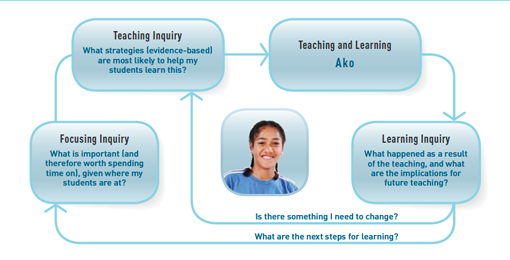
Teaching as Inquiry
The NZ Ministry of Education provides a series of web pages explaining what they define as Teaching as Inquiry there are several diagrammatic versions of the model proved, but all are similar to this one.
The Spiral of Inquiry
This is described on the MoE's TKI website as “a fresh rethink on the structure of teaching as inquiry.” (Ministry of Education, 2015). It emphasises involvement of learners, their families and communities and developing learner agency. It states that engaging in inquiry is a process of developing collective professional agency either within a school or across a cluster of schools. The approach is described in Timperley, Kaser and Halbert (2014). They emphasise agency and collaboration: "Engaging in inquiry is a process of developing collective professional agency either within a school or across a cluster of schools”, and “Nor can leaders decide what the focus of their inquiry should be. It is the collaborative inquiry process that matters”
The Spiral Playbook (Kaser & Halbert, 2017) provides an accessible overview of how to use the Spiral of Inquiry. It is included in this week's media and we will be using it in the face to face sessions. 
Which Inquiry Models are teachers using?
For the flipped preparation we asked you till fill in a form to say which teacher inquiry model(s) you are using. The form can he found at tinyurl.com/TMLteacherinquiry and we will share the results in class. Previous intakes have indicated that about half of teachers have used the Teaching as Inquiry model, while the other half used the Spiral of Inquiry, along with a handful of other models.
The online part of the programme will centre around your teacher inquiry.
Your inquiry can relate to any of the topics we’ve studied during the first 16 weeks, and you’ll still have access to those weeks’ content in the portal while studying online.
During the 16 weeks you will design an action plan informed by community needs and insights from research. You will then carry out the initial cycle of a Spiral of Inquiry while writing a series of reflections on different aspects of your inquiry.
References
Education Council. (2017). Our Code Our Standards: Code of Professional Responsibility and Standards for the Teaching Profession. Retrieved from https://educationcouncil.org.nz/sites/default/files/Our%20Code%20Our%20Standards%20web%20booklet%20FINAL.pdf
Hubbard, R. & Power, B. (2003). The Art of Classroom Inquiry: A Handbook for Teacher-Researchers (Revised Ed.). Portsmouth, NH: Heinemann.
Kaser, L. & Halbert, J. (2017). The Spiral Playbook: Leading with an inquiring mindset in school systems and schools. C21 Canada. Retrieved from http://c21canada.org/wp-content/uploads/2016/10/Spiral-Playbook.pdf
Ministry of Education. (2015). Before You Start. Retrieved from http://nzcurriculum.tki.org.nz/Teaching-as-inquiry/Before-you-start
Team Solutions. (2009). Thinking about Inquiry. Retrieved from http://teamsolutions.wikispaces.com/Teaching+as+Inquiry
Timperley, H., Kaser, L. & Halbert, J. (2014). A framework for transforming learning in schools: Innovation and the spiral of inquiry. Centre for Strategic Education. Retrieved from http://www.educationalleaders.govt.nz/content/download/74475/611763/file/Spiral%20of%20Inquiry%20Paper%20-%20Timperley%20Kaser%20Halbert.pdf

Wednesday, 24 October 2018

Leadership 14

Nationality Versus Culture
Nationality is not a very meaningful concept. Culture is much more significant. “It is remarkable how fast and how effectively you can construct a nationality with a flag, a few speeches, and a national anthem.” (Taleb, 2008). Nick Taleb, who might be described in these terms as a Lebanese American, is dismissive of nationality, he sees it as a largely meaningless way of defining someone.
School Culture
According to the Ministry of Education (2016), a school's culture consists of the customs, rituals, and stories that are evident and valued throughout the whole school. An effective school culture is one in which the customs and values foster success for all; and where clear boundaries are set, known, and agreed to by everyone. In developing a positive culture, effective principals ensure that educational practices are inclusive. They make certain that students and their families do not feel alienated either from their own culture or from the culture of the school.
New Formations of Whānau
According to Smith (1995), The concept of whānau provides the school with a synergy, enabling students, teachers, family and community members to assume a degree of agency over education, to articulate their aspirations, and to develop their capabilities together. This could provide another perspective on the relationship between school culture and community.
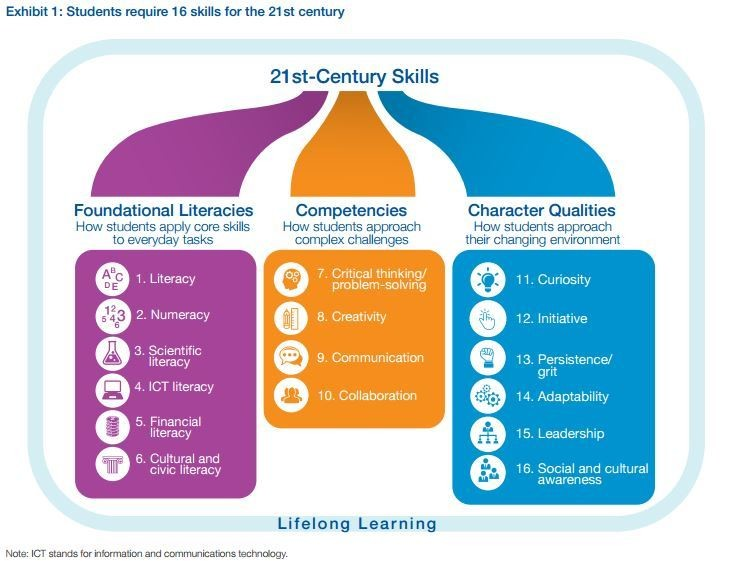
Cultural Literacy and Awareness as 21st Century Skills
Cultural awareness can also be considered part of the 21st century skill set. The following image from the World Economic Forum (2016) includes cultural and civic literacy and social and cultural awareness as 21st century skills.
In class, we'll consider how each of these images might provide analogy of cultural competence and what insight might this give you about how to work and lead effectively across cultures.
International Capabilities
The Ministry of Education (2014) defines international capabilities as the knowledge, skills, attitudes, dispositions, and values that make up the key competencies that enable people to live, work, and learn across national and cultural boundaries. Being internationally capable includes not only the awareness of other cultures, about also the awareness of one’s own culture as particular and specific. It involves the understanding that we all experience our lives through a number of cultural and personal "lenses", and that comprehending and accepting others’ needs and behaviours rests as much on understanding ourselves as it does on understanding them.
Responsive Leadership 
The new Leadership strategy from the Education Council (2018) states that "Educational leaders in Aotearoa New Zealand need to be aware and responsive to the nature of the relationship between Māori and government. They must be culturally knowledgeable and adept to lead successfully in the bicultural landscape of our country".
Curriculum Principles
A 2012 report by the ERO looked at how well the eight principles of the New Zealand Curriculum were represented in classrooms  The eight principles studied were: 
  • Coherence
  • Community engagement
  • Cultural diversity
  • Future focus
  • High expectations
  • Inclusion
  • Learning to learn
  • Treaty of Waitangi
The report found that “Cultural diversity, future focus and Treaty of Waitangi were the least well represented principles in approximately a third of classrooms. These three principles were not evident at all in about a sixth of classrooms.”(Educational Review Office, 2012).
A lot might have hopefully changed since, but we'll ideate in class how could continue to embed Cultural diversity and/or principles of Te Aho Matua or Te Tiriti o Waitangi in our context and what are the implications for leadership.  To do this we'll use these 4 resources to draw ideas from:
  • Educational Leadership Capability Framework (2018b) - particularly the second row on the table on page 8, that explains how leaders can 'Ensure culturally responsive practice and understanding of Aotearoa New Zealand’s cultural heritage, using Te Tiriti o Waitangi as the foundation'
  • Tapasā Cultural competencies framework for teachers of Pacific learners (2018) - particularly the 3 Turu tables that explain what leader can do relating to them 
  • Kei Tua o te Pae (n.d.) - don't open the pdf but scroll down the page instead to find the Early Childhood Exemplars and Frameworks for bicultural education
  • Tū Rangatira (English) Tū Rangatira (Māori) (2010) - Educational Leadership document that brings together shared ideas, experiences and leadership practices from the Māori medium education sector. 
PISA Tests
The Programme for International Student Assessment (PISA) is a worldwide study by the Organisation for Economic Co-operation and Development (OECD) in member and non-member nations of 15-year-old school pupils' scholastic performance in mathematics, science, and reading. 
In class, we'll try out one of these PISA 2015 Science or Financial Literacy tasks (You might need to zoom out in your browser using Ctrl -) If a page hangs when loading, just refresh the browser.
Science from http://www.oecd.org/pisa/test/ (main page)
Financial Literacy 
Changes to PISA since 2015
PISA has provided analysis of the  Excellence and Equity in Education and  Policies and Practices for Successful Schools already for years, but in 2015 they also provided information about the  Students' Financial Literacy and Collaborative Problem Solving
As an example, the Released Field Trial Cognitive Items document (PISA, 2015) includes an assessment unit where the premise is that a group of international students is coming to visit a school. The student must collaborate with 3 agent teammates and a faculty adviser to plan the visit, assign visitors to guides,and respond to an unexpected problem that arises. The assessment involves the following challenges requiring collaborative skills
  • solicit and take into account criteria for assessing the options
  • clarify statements made by teammates
  • correct misinformation and avoid deadlock
  • prompt team members to perform their tasks
  • ensure that the final recommendation meets all specified criteria
The student must collaborate with 3 agent teammates, a faculty adviser and respond to an unexpected problem
Wellbeing
2015 was the first time that PISA looked at also to Students Wellbeing. Three indicators werere chosen to make up the educational well-being dimension.
  1. PISA 2016 country score for education performance, averaged across reading,mathematics and science literacy test scores.
  2. inequality in achievement around these scores using the ratio of the score at the 90th percentile to the 10th percentileaveraged across the three PISA literacy measures.
  3. The proportions of 15-19 year-olds not in education and not in employment or training (NEET).
The PISA assessment placed New Zealand 13th out of 30 countries in terms of educational well-being. In particular, it found high levels of bullying in New Zealand schools (OECD, 2017).
Hauora - Well-being
Hauora is a Māori philosophy of health unique to New Zealand (Ministry of Education, 1999), that could maybe be one of the key concepts on developing more positive school cultures focused around students' wellbeing? The concept is recognised by the World Health Organisation and comprises the following types of well-being:
  • Taha tinana - Physical well-being - the physical body, its growth, development, and ability to move, and ways of caring for it
  • Taha hinengaro - Mental and emotional well-being - coherent thinking processes, acknowledging and expressing thoughts and feelings and responding constructively
  • Taha whanau - Social well-being - family relationships, friendships, and other interpersonal relationships; feelings of belonging, compassion, and caring; and social support
  • Taha wairua - Spiritual well-being - the values and beliefs that determine the way people live, the search for meaning and purpose in life, and personal identity and self-awareness (For some individuals and communities, spiritual well- being is linked to a particular religion; for others, it is not.)
Global Competence
The PISA 2018 added also global competence to be one of the assessed aspects (OECD, 2018), and it has these two components:
  1. A cognitive test about “global understanding”, which assesses knowledge and cognitive skills required to solve problems related to global and intercultural issues
  2. A questionnaire about students’ awareness, skills and attitudes regarding global issues and cultures, along with information from schools and teachers on activities to promote global competence.
Global understanding is assessed in the cognitive test by asking students to complete several test units based on case studies and scenario-based tasks.
Here is an example of part of the global competence questionnaire (OECD, 2018).
In class, we ask you to fill in this quick (Global Competence) appraisal survey of the Mind Lab Staff, which is based on the on in PISA (2018) tinyurl.com/TMLGlobalJuly18
The PISA discussion
Even if there are many positive affects in this sort of skills comparison it also provokes strong debate from educators the world over. When it was developed, it was created as a diagnostic tool to bring together education policymakers together to discuss and track education and education improvement. However, in recent years, it has become widely criticised as a league table that is used as a indicator of a country's education health. Sir Ken Robinson criticised PISA for “squeezing out” other more creative subjects and creating an anxiety around education that was “grotesque”. Academics from around the world expressed deep concern in the 'PISA letter' (The Guardian, 2014) about the impact of Pisa tests and call for a halt to the next round of testing.
However, as you have now seen, PISA tests are developed further all the time and they do assess an unprecedented range of learning outcomes and their contexts, including student performance measures, measures of social and emotional dimensions, student attitudes and motivations, equity issues, and parental support. Pearson has been chosen to develop the PISA 2018 Student Assessment 21st Century Framework (Pearson, 2014).
Does money buy strong performance in PISA? 
It has been shown that greater national wealth or higher expenditure on education does not guarantee better student performance. Among high-income economies, the amount spent on education is less important than how those resources are used. Successful school systems in high-income economies tend to prioritise the quality of teachers over the size of classes and school systems that perform well in PISA believe that all students can achieve, and give them the opportunity to do so.
References
Education Review Office. (2012). The New Zealand Curriculum Principles: Foundations for Curriculum Decision-Making. Retrieved from http://www.ero.govt.nz/publications/the-new-zealan...
Education Council. (2018b). Educational Leadership Capability Framework. Retrieved from https://educationcouncil.org.nz/sites/default/files/Leadership_Capability_Framework.pdf
Education Council. (2018a). The Leadership Strategy for the teaching profession of Aotearoa New Zealand, Retrieved from https://www.educationcouncil.org.nz/sites/default/...
Ministry of Education. (1999). Health and Physical Education in the New Zealand Curriculum. Retrieved from  http://health.tki.org.nz/Teaching-in-HPE/Health-and-PE-in-the-NZC/Health-and-PE-in-the-NZC-1999
Ministry of Education. (2014). International capabilities. Retrieved from: http://nzcurriculum.tki.org.nz/Curriculum-resources/International-capabilities
Ministry of Education. (2016). Areas of Practice. Retrieved from http://www.educationalleaders.govt.nz/Leadership-d...
Ministry of Education. (2018). Tapasā: Cultural competencies framework for teachers of Pacific learners. Retrieved from http://pasifika.tki.org.nz/content/download/2539/19100/file/Tapasa%CC%84-%20Cultural%20Competencies%20Framework%20for%20Teachers%20of%20Pacific%20Learners.pdf
Ministry of Education. (n.d). Frameworks for bicultural education. Retrieved from https://education.govt.nz/early-childhood/teaching...
OECD. (2017). PISA 2015 Results: Students' well-being. Retrieved from http://www.oecd-ilibrary.org/education/pisa-2015-results-volume-iii_9789264273856-en
OECD. (2018). Preparing our youth for an inclusive and sustainable world: The OECD PISA global competence framework. Retrieved from http://www.oecd.org/pisa/aboutpisa/Global-competency-for-an-inclusive-world.pdf
Pearson. (2014, December 10). Pearson to develop PISA 2018 Student Assessment 21st Century Frameworks for OECD. Retrieved from https://www.pearson.com/news/announcements/2014/december/pearson-to-develop-pisa-2018-student-assessment-21st-century-fra.html
PISA. (2015). Released Field Trial Cognitive Items. Retrieved from https://www.oecd.org/pisa/pisaproducts/PISA2015-Released-FT-Cognitive-Items.pdf
Smith, G. (1995). Whakaoho Whānau: New Formations of Whānau as an Innovative Intervention into Māori Cultural and Educational Crises. He Pukenga Korero, 1(1), 18–36.
Taleb, N. (2008). The Black Swan: The Impact of the Highly Improbable. Random House.
The Guardian. (2014, May 6). OECD and Pisa tests are damaging education worldwide - academics. The Guardian, Retrieved from https://www.theguardian.com/education/2014/may/06/oecd-pisa-tests-damaging-education-academics
World Economic Forum. (2016). New Vision for Education: Fostering Social and Emotional Learning through Technology. Retrieved from http://www3.weforum.org/docs/WEF_New_Vision_for_Education.pdf

Digital

Student Agency
Martin (2004, p. 135) characterises agency as "the capability of individual human beings to make choices and act on these choices in a way that makes a difference in their lives”. However, although we might believe that the most transformative learning comes from the learner’s own agency, Lindgren and McDaniel (2012, p.346) underline that “giving students the sense that they have control and the power to affect their own learning is one of the great challenges of contemporary education”.
Tim's To-Do List
In Tim Gander's video (in this week's in-class media), he talks about his to-do list for creating student agency based on his experience working with his own school students prior to joining The Mind Lab.
  • Creating an online learning community and shared meaning for agency
  • Defining the barriers
  • Problem solving how to work around those
  • 20%-25% time for personal projects (from Google)
  • Hacking the internal NCEA assessment standards
  • Using collaborative digital tools
  • Creating a flow chart for the (4) modules
  • Constraints and scaffolding
  • Iterate...
Classroom Focused Agency
A classroom focused interpretation of agency “emphasizes students’ active engagement within richly furnished curricular settings with the support of teachers who encourage student risk-taking and active, self-directed experimentation with the alternative possibilities available in such settings” (p. 144). 
Whānau Agency
The concept of whānau provides the school with a synergy, enabling students, teachers, family and community members to assume a degree of agency over education, to articulate their aspirations, and to develop their capabilities together (Smith, 1995).
Teacher Agency
Re-emphasising the teacher role as central to creating the learning environment - through designing rich tasks capable of facilitating higher order thinking and learning - could help recover the teacher’s sense of agency. (Kimber, Pillay & Richards, 2002). 
In class, we'll ideate how what new opportunities do digital and collaborative tools present for student, whānau and teacher agency.
Kahoot! Pedagogy
In this week's session we included a Kahoot! quiz. Tools such as Kahoot! and Quizizz are designed to be gamified and engaging. According to Icard (2014), students should be enticed by the competitive nature of the game if it is going to be a valuable learning experience for the students. They benefit from using digital games in the classroom by learning how to handle success and failure as well as how to use critical thinking and problem-solving skills.
After the Kahppt! we'll reflect were you engaged when playing it? If so, how do you know? And what is engagement? 
Engagement
Fredericks, Blumenfeld and Paris (2004) proposed a framework for considering engagement that distinguishes between cognitivebehavioural and emotional engagement. It is important to clarify the scope of the term ‘engagement’. Policy discussion has long focused on the negative consequences of disengagement, such as school dropout, and clear behavioural indicators, such as absenteeism and disruptive classroom behaviour. This often overlooks the complexity of engagement, especially the cognitive engagement of students who may be otherwise attending class and behaving well. A short paper form the Australian Institute for Teaching and School Leadership (2016) gives an interesting viewpoint and summary about those three types of engagement in schools - what does engagement mean and how can you measure it?
Shernoff (2013) states that engagement always connotes a relationship, one of involvement to something, and defines it as a heightened, simultaneous experience of concentration, interest, and enjoyment in the task at hand. His definition does not mention school, but refers to engagement in general.
Research indicates that meaningful engagement is composed of academic intensity and a positive emotional response. These can be fostered through clear goals and high expectations for performance, with complex tasks found to be relevant to students’ lives and the community at large.
Engagement and Flow
Definitions of engagement seem to resonate with the concept of flow experience (Csikszentmihalyi, 1990) that we looked at in the context of games. Although the nature of schoolwork can vary, the ideal state of engagement could perhaps be attained in active learning tasks that can support flow. Creating meaningful engagement requires attention to a variety of contextual, instructional, developmental, and interpersonal factors beyond the preoccupation with narrowly defined educational outcomes.
Flow and engagement can be contagious, having the potential to cross over from teacher to student, student to teacher, and permeate an entire group participating in a shared activity. New technologies may also help us to engage students.
References
Australian Institute for Teaching and School Leadership. (2016). Engagement in Australian schools. Retrieved from http://www.acleadersresource.sa.edu.au/features/engagement-in-learning/workshop-1/Handout_4_Engagement_in_Australian_Schools.pdf
Csikszentmihalyi, M. (1990). Flow: The Psychology of Optimal Experience. New York, NY: Harper & Row. 
Fredericks, J. A., Blumenfeld, P. C. & Paris, A. H. (2004). School Engagement: Potential of the Concept, State of the Evidence. Review of Educational Research, 74(1), 59-109.
Icard, S. B. (2014). Educational technology best practices. International Journal of Instructional Technology and Distance Learning. 11(3), 37-41. Retrieved from http://itdl.org/Journal/Mar_14/Mar14.pdf#page=41
Kimber, K., Pillay, H., & Richards, C. (2002). Reclaiming teacher agency in a student-centred digital world. Asia-Pacific Journal of Teacher Education, 30(2), 155-167.
Lindgren, R., & McDaniel, R. (2012). Transforming Online Learning through Narrative and Student Agency. Educational Technology & Society, 15(4), 344–355.
Martin, J. (2004). Self-Regulated Learning, Social Cognitive Theory, and Agency. Educational Psychologist, 39(2), 135-145.
Shernoff, D. (Ed. 2013). Optimal Learning Environments to Promote Student Engagement (Advancing Responsible Adolescent Development). Dordrecht: Springer.
Smith, G. (1995). Whakaoho Whānau: New Formations of Whānau as an Innovative Intervention into Māori Cultural and Educational Crises. He Pukenga Korero, 1(1), 18–36.

Wednesday, 17 October 2018

Week 13

'Cat on Yer Head'
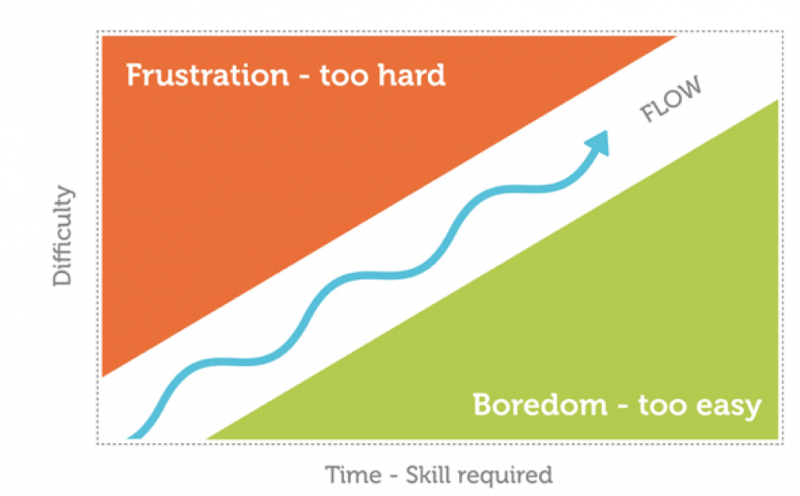
We will start the session by playing a game called 'Cat on Yer Head' (Davis, 2014). We will play it for a short time then think about how engaging it was. We will then discuss the relationships between the difficulty of the game and the skill levels we had to master it - this relates to the idea of 'flow'. According to Murphy (2011) Flow is widely accepted to be one of the fundamental reasons that people play games. It is the essence of games. For game designers, the question is not whether flow is important, but rather, how long you can keep your players in flow. This game is very flexible and it's easy to add, remove or change rules. We will add a new rule that we create in class then discuss what effects that had on flow. 
Clear tasks - understands what they are doing
Feedback - gives a lot of feedback about progressions towards goals
Balanced - attainable goal
Concentration - must be able to concentrate on the game and should avoid distracting the player away from the tasks.


Recently some researchers have begun to take an interest in how group dynamics and collaborative (or competitive) situations within groups affects flow (Madigan, 2015). Ryu, Cui and Parsons (2010) noted that 'social flow in a collaborative learning space might be a key factor in providing the conditions for optimal learning experience' (p.1). If you want to hear how the rules change when groups are involved, you should listen to Madigan interviewing Dr. Linda Kaye on his podcast episode of Psychological Flow.
Flipped Task Discussion - The design principles for flow experience in educational games
According to Kiili, "whenever people reflect on their flow experiences, they mention some, and often all, of the following characteristics: concentration, time distortion, rewarding experience and loss of self-consciousness. During a flow experience, such as during game-play, a person is totally focused on the activity and is able to forget all unpleasant things. Because flow-inducing activities require complete concentration of attention on the task at hand, there are no cognitive resources left over for irrelevant information. Thus, self seems to disappear from awareness during flow. In other words, in flow there is no room for self-scrutiny... during the flow experience the sense of time tends to bear little relation to the passage of time as measured by the absolute convention of a clock. Time seems to either pass really fast or the seconds may feel like minutes. Rewarding experience refers to an activity that is done, not with the expectation of some future benefit, but simply because the doing itself is interesting and fun". Therefore the characteristics of a flow experience are:-
  1. Challenge – The challenge level of the game was appropriate for me. It was neither too challenging nor too easy.
  2. Clear goals - I understood what I needed to do and achieve in the game. Thus, I think that the goals were clear for me
  3. Feedback - The game provided me with such feedback that I was aware how I was performing. I could really perceive the consequences of my actions.
  4. Playability - The user interface of the game was easy to use. I could easily find all the necessary functionalities and information.
  5. Sense of control - I felt that it could be possible to perform well in the game. Training could improve my skills to master the game.
  6. Rewarding experience - I really enjoyed the playing experience. It was so gratifying that I want to capture it again for its own sake
  7. Concentration - I was totally immersed with playing the game. External factors did not disturb me and I could keep my mind on the game events.
  8. Loss of self-consciousness - During playing I was not concerned with what others may have been thinking of my performance.
  9. Time distortion - During playing the time seemed to pass very fast - suddenly the playing session was almost over. 
Educational Game Model
According to Amory (2007), Educational computer games should:
  • Be relevant, explorative, emotive and engaging
  • Include complex challenges, puzzles or quests
  • Be gender-inclusive and non-confrontational
  • Provide appropriate role models
  • Develop democracy and social capital through dialogue
  • Support authentic learning activities
  • Support the construction of tacit knowledge
Educational games need all the usual qualities of games, plus they should not contain any socially undesirable features (racism. sexism, violence, etc) but provide positive models, plus they have to have some embedded pedagogy. Maybe this explains why successful educational games are so hard to create.Taking account, and including, all these features into a game is difficult. One good example that tries to include many of these elements is a Maori language game created by Tyne Crow -Kupu Hono.
You can try out a basic demo of Tyne Crow’s Kupu Hono Maori language learning game that is an example of a learning game designed for mobile devices that uses a virtual game world.
Game Design in Education
A starting point for game design in education could be a 'problem space':
"Games and simulations, digital or non-digital, are also problem spaces. They are constructed with particular constraints and affordances that shape what the player can experience as “the game”." McCall (2012)
"By being conscious of the ways in which games and simulations construct a particular problem space for learners, teachers can pay attention to the strengths and limitations of any particular game, and consider what additional ideas and facts need to be explicitly taught, or reflected on, outside the game experience". Bolstad, R. (2017).
In Class Task - Mindomo and Mind Maps
Use mindomo.com to summarise your ideas as an mindmap. The instructions for using mindomo mind maps are in the media section at the bottom of this page. 
Ideate a 'problem space'
"By being conscious of the ways in which games and simulations construct a particular problem space for learners, teachers can pay attention to the strengths and limitations of any particular game, and consider what additional ideas and facts need to be explicitly taught, or reflected on, outside the game experience. " (Bolstad, 2017).
Examples of 'problem spaces' might be:
  • History Events - Civil Rights
  • Science - Climate change
  • Student Self Management
  • Literacy - for a particular target group
Then add your chosen problem space to the middle of your mindmap and identify 3 or 4 game mechanics from Marczewski's Game Mechanics Table to ideate further.
Include key learning that you want to occur.
Give and receive feedback on your presentations in the G+ community 'In class tasks':
  • Chosen problem space?
  • What game mechanics have they used?
  • What learning are they wanting to encourage?
  • Something about the educational game criteria?
Keep in mind that these are ideas you could propose to your students, we hope they will develop the idea and game(s) further with you.
Game creation tools
One of the tools that could be used with students to create their own games is Gamefroot
  • GameSalad includes ready-to-use projects, activities, tutorials and assessments to meet STEM initiatives.
  • Yoyo Games Allows users to make 2D games with the GameMaker: Studio game engine is easy. No code or programming required.
  • Gamestar Mechanic uses fun, game-based quests and courses to help you learn game design and make your own video games!
  • Flow lab Visual game creator, right in your browser.  No coding needed - Export apps for iOS, Android & Windows
References
Amory, A. (2007). Game object model version II: a theoretical framework for educational game development. Educational Technology Research & Development, 55(1), 51–77
Bolstad, R. (2017). Playing for peace: Complex role-play gaming in high school history A case study. New Zealand Council for Educational Research.
Davis, R. (2014). Cat On Yer Head. Playniac Ltd. Retrieved from http://www.catonyerhead.com/
Kiili, K. , de Freitas, S. , Arnab, S. and Lainema, T. (2012) The design principles for flow experience in educational games. Procedia Computer Science, volume 15 (4th International Conference on Games and Virtual Worlds for Serious Applications (VS-GAMES’12)): 78– 91. http://dx.doi.org/10.1016/j.procs.2012.10.060
Madigan, J. (2015). Podcast 3: Psychological Flow. The Psychology of Video Games. Retrieved from http://www.psychologyofgames.com/2015/05/podcast-3-psychological-flow/
Marczewski, A. (2016). GameThinking – Differences Between Gamification & Games. Gamified UK. Retrieved from: http://www.gamified.uk/gamification-framework/differences-between-gamification-and-games/
McCall, J. (2012). Historical simulations as problem spaces: Criticism and classroom use. Journal of Digital Humanities, 1(2).
Murphy, C. (2011). Why Games Work and the Science of Learning. In Proceedings Modsim World 2011. Retrieved from: https://ntrs.nasa.gov/archive/nasa/casi.ntrs.nasa.gov/20130008648.pdf
Ryu, H., Cui, J. & Parsons, D. (2010). Raising the Bar of Challenge with Collaboration: Social Flow in Mobile Learning. Proceedings of 9th World Conference on Mobile and Contextual Learning (mLearn 2010), Malta, (pp. 240-247). Retrieved from http://davidparsons.ac.nz/papers/Raising%20the%20Bar%20of%20Challenge%20with%20Collaboration%20Social%20Flow%20in%20Mobile%20Learning.pdf
Salen, K. (Ed.) (2007). The Ecology of Games: Connecting Youth, Games, and Learning. Cambridge, Mass.: MIT Press.