Mindlab - Action reflections

Showing posts with label Leadership. Show all posts

Wednesday, 24 October 2018

Leadership 14

Nationality Versus Culture
Nationality is not a very meaningful concept. Culture is much more significant. “It is remarkable how fast and how effectively you can construct a nationality with a flag, a few speeches, and a national anthem.” (Taleb, 2008). Nick Taleb, who might be described in these terms as a Lebanese American, is dismissive of nationality, he sees it as a largely meaningless way of defining someone.
School Culture
According to the Ministry of Education (2016), a school's culture consists of the customs, rituals, and stories that are evident and valued throughout the whole school. An effective school culture is one in which the customs and values foster success for all; and where clear boundaries are set, known, and agreed to by everyone. In developing a positive culture, effective principals ensure that educational practices are inclusive. They make certain that students and their families do not feel alienated either from their own culture or from the culture of the school.
New Formations of Whānau
According to Smith (1995), The concept of whānau provides the school with a synergy, enabling students, teachers, family and community members to assume a degree of agency over education, to articulate their aspirations, and to develop their capabilities together. This could provide another perspective on the relationship between school culture and community.
Cultural Literacy and Awareness as 21st Century Skills
Cultural awareness can also be considered part of the 21st century skill set. The following image from the World Economic Forum (2016) includes cultural and civic literacy and social and cultural awareness as 21st century skills.
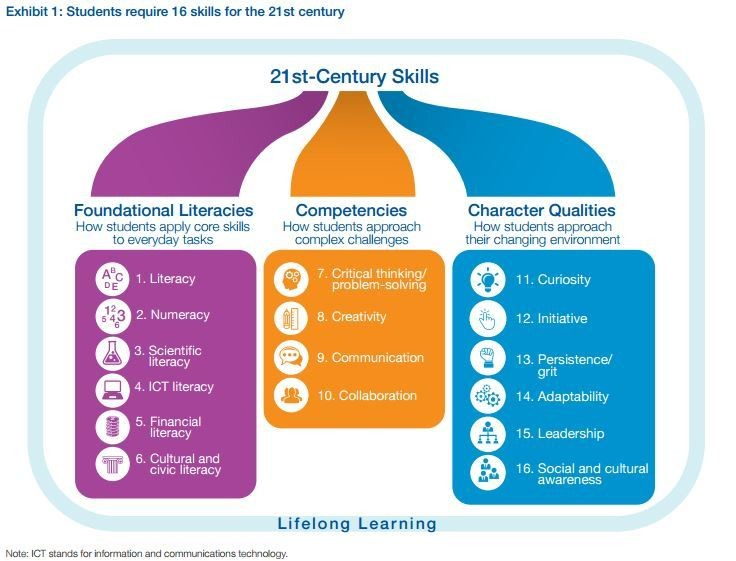
In class, we'll consider how each of these images might provide analogy of cultural competence and what insight might this give you about how to work and lead effectively across cultures.

International Capabilities
The Ministry of Education (2014) defines international capabilities as the knowledge, skills, attitudes, dispositions, and values that make up the key competencies that enable people to live, work, and learn across national and cultural boundaries. Being internationally capable includes not only the awareness of other cultures, about also the awareness of one’s own culture as particular and specific. It involves the understanding that we all experience our lives through a number of cultural and personal "lenses", and that comprehending and accepting others’ needs and behaviours rests as much on understanding ourselves as it does on understanding them.
Responsive Leadership 
The new Leadership strategy from the Education Council (2018) states that "Educational leaders in Aotearoa New Zealand need to be aware and responsive to the nature of the relationship between Māori and government. They must be culturally knowledgeable and adept to lead successfully in the bicultural landscape of our country".
Curriculum Principles
A 2012 report by the ERO looked at how well the eight principles of the New Zealand Curriculum were represented in classrooms  The eight principles studied were: 
  • Coherence
  • Community engagement
  • Cultural diversity
  • Future focus
  • High expectations
  • Inclusion
  • Learning to learn
  • Treaty of Waitangi
The report found that “Cultural diversity, future focus and Treaty of Waitangi were the least well represented principles in approximately a third of classrooms. These three principles were not evident at all in about a sixth of classrooms.”(Educational Review Office, 2012).
A lot might have hopefully changed since, but we'll ideate in class how could continue to embed Cultural diversity and/or principles of Te Aho Matua or Te Tiriti o Waitangi in our context and what are the implications for leadership.  To do this we'll use these 4 resources to draw ideas from:
  • Educational Leadership Capability Framework (2018b) - particularly the second row on the table on page 8, that explains how leaders can 'Ensure culturally responsive practice and understanding of Aotearoa New Zealand’s cultural heritage, using Te Tiriti o Waitangi as the foundation'
  • Tapasā Cultural competencies framework for teachers of Pacific learners (2018) - particularly the 3 Turu tables that explain what leader can do relating to them 
  • Kei Tua o te Pae (n.d.) - don't open the pdf but scroll down the page instead to find the Early Childhood Exemplars and Frameworks for bicultural education
  • Tū Rangatira (English) Tū Rangatira (Māori) (2010) - Educational Leadership document that brings together shared ideas, experiences and leadership practices from the Māori medium education sector. 
PISA Tests
The Programme for International Student Assessment (PISA) is a worldwide study by the Organisation for Economic Co-operation and Development (OECD) in member and non-member nations of 15-year-old school pupils' scholastic performance in mathematics, science, and reading. 
In class, we'll try out one of these PISA 2015 Science or Financial Literacy tasks (You might need to zoom out in your browser using Ctrl -) If a page hangs when loading, just refresh the browser.
Science from http://www.oecd.org/pisa/test/ (main page)
Financial Literacy 
Changes to PISA since 2015
PISA has provided analysis of the  Excellence and Equity in Education and  Policies and Practices for Successful Schools already for years, but in 2015 they also provided information about the  Students' Financial Literacy and Collaborative Problem Solving. 
As an example, the Released Field Trial Cognitive Items document (PISA, 2015) includes an assessment unit where the premise is that a group of international students is coming to visit a school. The student must collaborate with 3 agent teammates and a faculty adviser to plan the visit, assign visitors to guides,and respond to an unexpected problem that arises. The assessment involves the following challenges requiring collaborative skills
  • solicit and take into account criteria for assessing the options
  • clarify statements made by teammates
  • correct misinformation and avoid deadlock
  • prompt team members to perform their tasks
  • ensure that the final recommendation meets all specified criteria
The student must collaborate with 3 agent teammates, a faculty adviser and respond to an unexpected problem
Wellbeing
2015 was the first time that PISA looked at also to Students Wellbeing. Three indicators werere chosen to make up the educational well-being dimension.
  1. PISA 2016 country score for education performance, averaged across reading,mathematics and science literacy test scores.
  2. inequality in achievement around these scores using the ratio of the score at the 90th percentile to the 10th percentileaveraged across the three PISA literacy measures.
  3. The proportions of 15-19 year-olds not in education and not in employment or training (NEET).
The PISA assessment placed New Zealand 13th out of 30 countries in terms of educational well-being. In particular, it found high levels of bullying in New Zealand schools (OECD, 2017).
Hauora - Well-being
Hauora is a Māori philosophy of health unique to New Zealand (Ministry of Education, 1999), that could maybe be one of the key concepts on developing more positive school cultures focused around students' wellbeing? The concept is recognised by the World Health Organisation and comprises the following types of well-being:
  • Taha tinana - Physical well-being - the physical body, its growth, development, and ability to move, and ways of caring for it
  • Taha hinengaro - Mental and emotional well-being - coherent thinking processes, acknowledging and expressing thoughts and feelings and responding constructively
  • Taha whanau - Social well-being - family relationships, friendships, and other interpersonal relationships; feelings of belonging, compassion, and caring; and social support
  • Taha wairua - Spiritual well-being - the values and beliefs that determine the way people live, the search for meaning and purpose in life, and personal identity and self-awareness (For some individuals and communities, spiritual well- being is linked to a particular religion; for others, it is not.)
Global Competence
The PISA 2018 added also global competence to be one of the assessed aspects (OECD, 2018), and it has these two components:
  1. A cognitive test about “global understanding”, which assesses knowledge and cognitive skills required to solve problems related to global and intercultural issues
  2. A questionnaire about students’ awareness, skills and attitudes regarding global issues and cultures, along with information from schools and teachers on activities to promote global competence.
Global understanding is assessed in the cognitive test by asking students to complete several test units based on case studies and scenario-based tasks.
Here is an example of part of the global competence questionnaire (OECD, 2018).
In class, we ask you to fill in this quick (Global Competence) appraisal survey of the Mind Lab Staff, which is based on the on in PISA (2018) tinyurl.com/TMLGlobalJuly18
The PISA discussion
Even if there are many positive affects in this sort of skills comparison it also provokes strong debate from educators the world over. When it was developed, it was created as a diagnostic tool to bring together education policymakers together to discuss and track education and education improvement. However, in recent years, it has become widely criticised as a league table that is used as a indicator of a country's education health. Sir Ken Robinson criticised PISA for “squeezing out” other more creative subjects and creating an anxiety around education that was “grotesque”. Academics from around the world expressed deep concern in the 'PISA letter' (The Guardian, 2014) about the impact of Pisa tests and call for a halt to the next round of testing.
However, as you have now seen, PISA tests are developed further all the time and they do assess an unprecedented range of learning outcomes and their contexts, including student performance measures, measures of social and emotional dimensions, student attitudes and motivations, equity issues, and parental support. Pearson has been chosen to develop the PISA 2018 Student Assessment 21st Century Framework (Pearson, 2014).
Does money buy strong performance in PISA? 
It has been shown that greater national wealth or higher expenditure on education does not guarantee better student performance. Among high-income economies, the amount spent on education is less important than how those resources are used. Successful school systems in high-income economies tend to prioritise the quality of teachers over the size of classes and school systems that perform well in PISA believe that all students can achieve, and give them the opportunity to do so.
References
Education Review Office. (2012). The New Zealand Curriculum Principles: Foundations for Curriculum Decision-Making. Retrieved from http://www.ero.govt.nz/publications/the-new-zealan...
Education Council. (2018b). Educational Leadership Capability Framework. Retrieved from https://educationcouncil.org.nz/sites/default/files/Leadership_Capability_Framework.pdf
Education Council. (2018a). The Leadership Strategy for the teaching profession of Aotearoa New Zealand, Retrieved from https://www.educationcouncil.org.nz/sites/default/...
Ministry of Education. (1999). Health and Physical Education in the New Zealand Curriculum. Retrieved from  http://health.tki.org.nz/Teaching-in-HPE/Health-and-PE-in-the-NZC/Health-and-PE-in-the-NZC-1999
Ministry of Education. (2014). International capabilities. Retrieved from: http://nzcurriculum.tki.org.nz/Curriculum-resources/International-capabilities
Ministry of Education. (2016). Areas of Practice. Retrieved from http://www.educationalleaders.govt.nz/Leadership-d...
Ministry of Education. (2018). Tapasā: Cultural competencies framework for teachers of Pacific learners. Retrieved from http://pasifika.tki.org.nz/content/download/2539/19100/file/Tapasa%CC%84-%20Cultural%20Competencies%20Framework%20for%20Teachers%20of%20Pacific%20Learners.pdf
Ministry of Education. (n.d). Frameworks for bicultural education. Retrieved from https://education.govt.nz/early-childhood/teaching...
OECD. (2017). PISA 2015 Results: Students' well-being. Retrieved from http://www.oecd-ilibrary.org/education/pisa-2015-results-volume-iii_9789264273856-en
OECD. (2018). Preparing our youth for an inclusive and sustainable world: The OECD PISA global competence framework. Retrieved from http://www.oecd.org/pisa/aboutpisa/Global-competency-for-an-inclusive-world.pdf
Pearson. (2014, December 10). Pearson to develop PISA 2018 Student Assessment 21st Century Frameworks for OECD. Retrieved from https://www.pearson.com/news/announcements/2014/december/pearson-to-develop-pisa-2018-student-assessment-21st-century-fra.html
PISA. (2015). Released Field Trial Cognitive Items. Retrieved from https://www.oecd.org/pisa/pisaproducts/PISA2015-Released-FT-Cognitive-Items.pdf
Smith, G. (1995). Whakaoho Whānau: New Formations of Whānau as an Innovative Intervention into Māori Cultural and Educational Crises. He Pukenga Korero, 1(1), 18–36.
Taleb, N. (2008). The Black Swan: The Impact of the Highly Improbable. Random House.
The Guardian. (2014, May 6). OECD and Pisa tests are damaging education worldwide - academics. The Guardian, Retrieved from https://www.theguardian.com/education/2014/may/06/oecd-pisa-tests-damaging-education-academics
World Economic Forum. (2016). New Vision for Education: Fostering Social and Emotional Learning through Technology. Retrieved from http://www3.weforum.org/docs/WEF_New_Vision_for_Education.pdf

Wednesday, 17 October 2018

Week 13

'Cat on Yer Head'
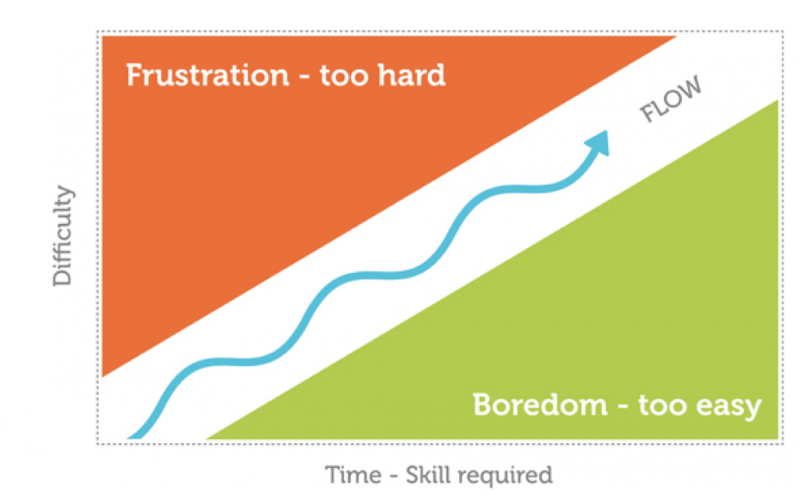
We will start the session by playing a game called 'Cat on Yer Head' (Davis, 2014). We will play it for a short time then think about how engaging it was. We will then discuss the relationships between the difficulty of the game and the skill levels we had to master it - this relates to the idea of 'flow'. According to Murphy (2011) Flow is widely accepted to be one of the fundamental reasons that people play games. It is the essence of games. For game designers, the question is not whether flow is important, but rather, how long you can keep your players in flow. This game is very flexible and it's easy to add, remove or change rules. We will add a new rule that we create in class then discuss what effects that had on flow. 
Clear tasks - understands what they are doing
Feedback - gives a lot of feedback about progressions towards goals
Balanced - attainable goal
Concentration - must be able to concentrate on the game and should avoid distracting the player away from the tasks.


Recently some researchers have begun to take an interest in how group dynamics and collaborative (or competitive) situations within groups affects flow (Madigan, 2015). Ryu, Cui and Parsons (2010) noted that 'social flow in a collaborative learning space might be a key factor in providing the conditions for optimal learning experience' (p.1). If you want to hear how the rules change when groups are involved, you should listen to Madigan interviewing Dr. Linda Kaye on his podcast episode of Psychological Flow.
Flipped Task Discussion - The design principles for flow experience in educational games
According to Kiili, "whenever people reflect on their flow experiences, they mention some, and often all, of the following characteristics: concentration, time distortion, rewarding experience and loss of self-consciousness. During a flow experience, such as during game-play, a person is totally focused on the activity and is able to forget all unpleasant things. Because flow-inducing activities require complete concentration of attention on the task at hand, there are no cognitive resources left over for irrelevant information. Thus, self seems to disappear from awareness during flow. In other words, in flow there is no room for self-scrutiny... during the flow experience the sense of time tends to bear little relation to the passage of time as measured by the absolute convention of a clock. Time seems to either pass really fast or the seconds may feel like minutes. Rewarding experience refers to an activity that is done, not with the expectation of some future benefit, but simply because the doing itself is interesting and fun". Therefore the characteristics of a flow experience are:-
  1. Challenge – The challenge level of the game was appropriate for me. It was neither too challenging nor too easy.
  2. Clear goals - I understood what I needed to do and achieve in the game. Thus, I think that the goals were clear for me
  3. Feedback - The game provided me with such feedback that I was aware how I was performing. I could really perceive the consequences of my actions.
  4. Playability - The user interface of the game was easy to use. I could easily find all the necessary functionalities and information.
  5. Sense of control - I felt that it could be possible to perform well in the game. Training could improve my skills to master the game.
  6. Rewarding experience - I really enjoyed the playing experience. It was so gratifying that I want to capture it again for its own sake
  7. Concentration - I was totally immersed with playing the game. External factors did not disturb me and I could keep my mind on the game events.
  8. Loss of self-consciousness - During playing I was not concerned with what others may have been thinking of my performance.
  9. Time distortion - During playing the time seemed to pass very fast - suddenly the playing session was almost over. 
Educational Game Model
According to Amory (2007), Educational computer games should:
  • Be relevant, explorative, emotive and engaging
  • Include complex challenges, puzzles or quests
  • Be gender-inclusive and non-confrontational
  • Provide appropriate role models
  • Develop democracy and social capital through dialogue
  • Support authentic learning activities
  • Support the construction of tacit knowledge
Educational games need all the usual qualities of games, plus they should not contain any socially undesirable features (racism. sexism, violence, etc) but provide positive models, plus they have to have some embedded pedagogy. Maybe this explains why successful educational games are so hard to create.Taking account, and including, all these features into a game is difficult. One good example that tries to include many of these elements is a Maori language game created by Tyne Crow -Kupu Hono.
You can try out a basic demo of Tyne Crow’s Kupu Hono Maori language learning game that is an example of a learning game designed for mobile devices that uses a virtual game world.
Game Design in Education
A starting point for game design in education could be a 'problem space':
"Games and simulations, digital or non-digital, are also problem spaces. They are constructed with particular constraints and affordances that shape what the player can experience as “the game”." McCall (2012)
"By being conscious of the ways in which games and simulations construct a particular problem space for learners, teachers can pay attention to the strengths and limitations of any particular game, and consider what additional ideas and facts need to be explicitly taught, or reflected on, outside the game experience". Bolstad, R. (2017).
In Class Task - Mindomo and Mind Maps
Use mindomo.com to summarise your ideas as an mindmap. The instructions for using mindomo mind maps are in the media section at the bottom of this page. 
Ideate a 'problem space'
"By being conscious of the ways in which games and simulations construct a particular problem space for learners, teachers can pay attention to the strengths and limitations of any particular game, and consider what additional ideas and facts need to be explicitly taught, or reflected on, outside the game experience. " (Bolstad, 2017).
Examples of 'problem spaces' might be:
  • History Events - Civil Rights
  • Science - Climate change
  • Student Self Management
  • Literacy - for a particular target group
Then add your chosen problem space to the middle of your mindmap and identify 3 or 4 game mechanics from Marczewski's Game Mechanics Table to ideate further.
Include key learning that you want to occur.
Give and receive feedback on your presentations in the G+ community 'In class tasks':
  • Chosen problem space?
  • What game mechanics have they used?
  • What learning are they wanting to encourage?
  • Something about the educational game criteria?
Keep in mind that these are ideas you could propose to your students, we hope they will develop the idea and game(s) further with you.
Game creation tools
One of the tools that could be used with students to create their own games is Gamefroot. 
  • GameSalad includes ready-to-use projects, activities, tutorials and assessments to meet STEM initiatives.
  • Yoyo Games Allows users to make 2D games with the GameMaker: Studio game engine is easy. No code or programming required.
  • Gamestar Mechanic uses fun, game-based quests and courses to help you learn game design and make your own video games!
  • Flow lab Visual game creator, right in your browser.  No coding needed - Export apps for iOS, Android & Windows
References
Amory, A. (2007). Game object model version II: a theoretical framework for educational game development. Educational Technology Research & Development, 55(1), 51–77
Bolstad, R. (2017). Playing for peace: Complex role-play gaming in high school history A case study. New Zealand Council for Educational Research.
Davis, R. (2014). Cat On Yer Head. Playniac Ltd. Retrieved from http://www.catonyerhead.com/
Kiili, K. , de Freitas, S. , Arnab, S. and Lainema, T. (2012) The design principles for flow experience in educational games. Procedia Computer Science, volume 15 (4th International Conference on Games and Virtual Worlds for Serious Applications (VS-GAMES’12)): 78– 91. http://dx.doi.org/10.1016/j.procs.2012.10.060
Madigan, J. (2015). Podcast 3: Psychological Flow. The Psychology of Video Games. Retrieved from http://www.psychologyofgames.com/2015/05/podcast-3-psychological-flow/
Marczewski, A. (2016). GameThinking – Differences Between Gamification & Games. Gamified UK. Retrieved from: http://www.gamified.uk/gamification-framework/differences-between-gamification-and-games/
McCall, J. (2012). Historical simulations as problem spaces: Criticism and classroom use. Journal of Digital Humanities, 1(2).
Murphy, C. (2011). Why Games Work and the Science of Learning. In Proceedings Modsim World 2011. Retrieved from: https://ntrs.nasa.gov/archive/nasa/casi.ntrs.nasa.gov/20130008648.pdf
Ryu, H., Cui, J. & Parsons, D. (2010). Raising the Bar of Challenge with Collaboration: Social Flow in Mobile Learning. Proceedings of 9th World Conference on Mobile and Contextual Learning (mLearn 2010), Malta, (pp. 240-247). Retrieved from http://davidparsons.ac.nz/papers/Raising%20the%20Bar%20of%20Challenge%20with%20Collaboration%20Social%20Flow%20in%20Mobile%20Learning.pdf
Salen, K. (Ed.) (2007). The Ecology of Games: Connecting Youth, Games, and Learning. Cambridge, Mass.: MIT Press.

Wednesday, 26 September 2018

Agile and servant - Leadership - week 10

Agile Teams are Self-Organising Teams
Peha’s (2011) version of the 12 principles of the agile manifesto reinterprets the last two as follows:
  • The best ideas and initiatives emerge from self-organizing teams
  • At regular intervals, teams reflect on how to become more effective, then tune and adjust their behavior accordingly
We will explore this idea using a combination of Boris Gloger’s Ball Point game (Gloger, 2008) and Mike Rother’s Kata in the Classroom (Rother, 2015).  Kata is a term from martial arts. The Improvement Kata is a repeating routine for continuous improvement. 
The following diagram of the improvement kata process is adapted from material on the katatogrow.com website.
The goal of the ball point game is for each team to get as many balls as possible to pass through the hands of every team member in 2 minutes. The game involves both estimation and self-organisation. 
- You have four rounds to iterate quickly and improve by trying different strategies.
- You always have 2 minutes in between the iterations to update the scorecard and re-strategise.
The four  basic requirements of the game are that:
  1. As each ball is passed between team members, it must have air time
  2. Every team member must touch each ball for it to count
  3. No ball to your direct neighbour on either side, you must pass to your front
  4. Every ball must end where it started. For each ball that does, the team scores 1 point (make sure you count your points)
Scrum is an Agile Process
Scrum is a lightweight process framework for agile development. It is an iterative process that consists of a series of sprints that each deliver something useful. It enables teams to self-organize and collaborate, and accepts that the problem cannot be fully understood or defined up front.
In Scrum, the product backlog (of user stories) is broken down into a series of sprints. In each sprint, a priority list of stories (the sprint backlog) is chosen for completion. The sprint lasts for a certain period of time (e.g. 2 weeks, 30 days etc.). There are daily stand up meetings during the sprint, and at the end of each sprint a working increment of the software is delivered. In other words, it is only a successful sprint if it delivers something useful.
Agile Leadership Styles
Agile leadership is situational, adaptive, empowering and inspirational. The most important leadership theory applied to agile is that of servant leadership (Highsmith, 2009).
“For the Agile Leader, servanthood is the strategy. Situational actions are the tactic” (Filho, 2011).
The key characteristics of the servant leader include awareness, listening, persuasion, empathy, healing, and coaching. Situational leadership means that the servant leader may act as a democratic leader, a laissez-faire leader, or an autocratic leader in different situations (Koganti, 2014).
Servant Leadership
The originator of the servant leadership concept (though inspired by a Herman Hesse story) was Robert Greenleaf. “The servant­ leader is servant first... It begins with the natural feeling that one wants to serve, to serve first. Then conscious choice brings one to aspire to lead.” (Greenleaf, 1970). A longer extract from this work, which was this week's flipped preparation activity, is in this week's media
Teachers as Servant Leaders
Servant leadership has been applied by a number of authors to teaching. “The teacher as servant leader functions as a trailblazer for those served by removing obstacles that stand in their path. Part of unleashing another’s talents is helping individuals discover latent, unformed interests. Art, music, and science teachers are prime examples of educators whose genius lies in leading students to discover unarticulated interests.” (Bowman, 2005).
Ten Characteristics of a Servant Leader
  1. Listening
  2. Empathy
  3. Healing
  4. Awareness
  5. Persuasion
  6. Conceptualization
  7. Foresight
  8. Stewardship
  9. Commitment to Growth of People
  10. Building Community
These characteristics, that come from Northouse (2013), are outlined in a blog post by Penn State (2013).
You may find this Servant Leadership in Teachers tinyurl.com/TMLServantTeacher blogpost a helpful source to create a story card in the Trello board's learning backlog.
This Week’s Software
We will be using Trello for one of the activities in this week’s session. One of the flipped preparation activities is to set up an account and familiarise yourself with this tool in advance. Please take a look at the Trello 101 guide before the session.
Mindset of an Agile Leader - The best always want to get better

Agile Methods
The Agile movement proposes alternatives to traditional project management. Agile approaches, such as Scrum and eXtreme programming  were designed for the software development to help businesses respond to unpredictability. Aspects of Lean production (from the Toyota Production System) are also increasingly utilised by agile practitioners, for example Kanban boards, where limiting the number of current work items enhances workflow. Kanban's 'pull' model makes the flow of work visible across the team. In software development, 'Scrumban' is a popular fusion of Scrum and Kanban.
Nowadays Agile and Lean practices are used in industries outside of manufacturing and software development. Agile is recognized more generally now as simply a great way of getting things done in rapidly changing and highly unpredictable situations.
Agile and Lean Ideas in Learning
In this week's classes we ponder what Agile and Lean methods can offer to the education sector. Even though Agile was developed within the software industry, and lean in car manufacturing, the link is that they are fundamentally about learning, people, and change. Many are amazed at how easily Agile and Lean ideas translate into education, and how perfectly-suited they are, for example, to running schools.
Whakataukī
Ka pū te ruha, ka hao te rangatahi
As an old net withers another is remade
Related Standards for the Teaching Profession
Learning Focused Culture
Develop learning-focused relationships with learners, enabling them to be active participants in the process of learning, sharing ownership and responsibility for learning.
He ahurea akoranga
Me whakawhanake i te whanaungatanga i roto i ngā mahi ako i te taha o ngā ākonga, e āhei ai rātou ki ngā mahi hihiri i roto i te tukanga akoranga, me te whai mana whai haepapa mō ā rātou mahi akoranga.

Digital Leadership - week 10

Agile in Education
What can you most use in your teaching?
Something that gives value to the learner.
Using Inquiry - teaching the skills - learner learning what they need based on their interests.

What is the most challenging idea?
we have a curriculum - how do you know you have coverage?
How would you resource it?
The lean enterprise - a school - how do you know that the whole journey is lean? What feeder schools.
Different schools focusing on specific areas of the curriculum. Children book into that particular school to cater for their needs. So maths at one school. Literacy at a different school.
Lean is ...


A number of authors have looked at ways that ideas from agile software development might translate into schools. For example Steve Peha, a technologist and educator in the US, has worked extensively in applying the lessons of agile and lean to the classroom. He writes “We talk a lot in education about creating a culture of learning in our schools. But we don’t have reliable ways of creating this culture. Agile does” (Peha, 2011).
Agile brings in a culture of learning - Peha

The Agile Manifesto
The Manifesto for Agile Software Development (Beck et al., 2001) was created in 2001 by a group of software development experts who had been exploring new ways of exercising their craft in the late 1990s. The manifesto provides four values and twelve principles to guide the agile software developer. The four values are: 
  • Individuals and interactions over processes and tools
  • Working software over comprehensive documentation
  • Customer collaboration over contract negotiation
  • Responding to change over following a plan
Peha (2011) provides some interesting ideas on how the agile manifesto can be reinterpreted to apply to schools, and how agile techniques might be used in the classroom. 
There are a lot of terms used this week, so here is a brief glossary of the main ones
  • Lean - an approach from the Japanese car industry that emphasises efficiency in workflow
  • Agile - approach from software development that emphasises being adaptable to change and communication within teams and with customers
  • Kaizan - a process of continuous improvement (from lean manufacturing)
  • Kaikaku - a process of radical change/improvement (from lean manufacturing)
  • Scrum - an agile software development method that emphasises teamwork
  • Stand Up Meeting - a Scrum technique were daily team stand up meetings are held - each team member reports on what they did yesterday, what they will do today, and any obstacles they are facing
  • Sprint - a cycle of activity during a Scrum process - each sprint is the same length and must result in a specific outcome.
  • Kanban - a story board that tracks progress of story cards from to do, doing and done. 
  • WIP  - 'work in progress' - a limit on how many stories can be in 'doing' on a kanban board at any one time
  • Servant Leadership - a leadership theory that is often applied to leading agile teams
  • Situational Leadership - a leadership theory that adapts its styles according to the needs of followers
  • Kata - a term from martial arts that defines a continually repeated exercise
  • Trello - a software tool that allows you to add multiple columns and cards. It can be adapted for many tasks. including creating a kanban board
  • Pull and Push - In lean manufacturing, 'pull' is preferred to 'push' - in 'pull' the tasks are pulled by the workers when they are ready, not pushed at them
  • Flow - The way that tasks flow through a kanban board when pull and WIP limits are used
Kanban
One of the ideas that has been taken from Lean Production by Agile practitioners is Kanban - which means 'visual card' in Japanese. This enables ‘Pull’ and ‘Flow’ (Anderson, 2010).
For an example of how Kanban boards can be used to help children plan, see Princess Kanban. This is on the agileschool blog, which you may find interesting. More recent materials are now on the Agile Classrooms site.
You can ‘Visualise the workflow’ by having e.g. these four columns on the Kanban board:
Learning backlogThings to be learnt nextThings we are learningThings we have learnt
These boards can be done digitally or just on the wall with super sticky post-its. They can be individual or shared with a team. We’ll work today with one that is shared with the whole class. 
User Stories 
In software development and product management user story statements are often written on story cards following the format: As a (role) I want (something) so that (benefit). The idea is to capture what a user does or needs to do as part of his or her job function. It captures the "who", "what" and "why" of a requirement in a simple, concise way, often limited in detail by what can be hand-written on a small piece of paper. However, there is no requirement that all user stories should be written this way. Our 'learning stories' in the sessions will be written in a more unstructured style as they will be more open ended than software requirements.
Stories will be written on the story cards that move across the Kanban board columns. Each one will be a short, simple description of something to be achieved in a short time frame They need to be small and focused enough to be achieved in a short time frame and allow for success to be tested. 
Epics
A story that is too big is known as an ‘epic’ and has to be broken down into smaller stories. ‘Introduce BYOD to the school’ is an epic, and ‘Introduce BYOD to one pilot class’ is still too big. However, ‘Send a survey to families from one class asking if they are willing to provide a device for their child to bring to school’ is a smaller, story-sized step
3 C's
User stories have three critical aspects. We can call these Card, Conversation, and Confirmation. The card is the trigger for a deeper conversation between stakeholders about the solution and takes place over time and is mostly verbal. The confirmation is an acceptance test - how we know when the story is done. (Jeffries, 2001). A good story card will likely end up with the back covered with results of the conversation(s) and confirmation tests.
Todays’ story cards for the first 2 sprints are developed from a forthcoming book chapter “Agile Education, Lean Learning" (in this week's media). You can use this or any other sources today when learning and problem solving. We hole these User Stories guide you towards Meaningful Learning on how Agile and Lean Approaches could help you in your practice.
Trello
Trello is one of the tools that can be used to create Kanban style boards online. It is an easy-to-use, free and visual way to manage your projects and organise anything. Naturally, there are other tools too, but this one seems to be the most popular right now, and amongst teachers and their students too.
For this week's session, each location will have its own Kanban board (see below for links)
Scrum Masters
For the main activity in the session, each team will have a scrum master. The scrum master is the team’s servant leader, who needs to:
  • make sure that just one or two of your team cards are moved in “Things we are learning” at one time
  • write an acceptance test first in the description of the card - so that you know how to justify confirmation and record the outcome of the confirmation to the description before moving the card to “Things we have learnt”
  • record the team’s main conversations as comments
  • be ready for the stand up meeting on time, to share in 1min:
    • What was the Meaningful Learning on How Agile and Lean Approaches Could Help You In Your Practice? (That’s the goal for all team members!)
    • Was the learning confirmed (acceptance test)? What (same or new User Stories) are you going to work with on the next scrum? Any obstacles?
References
Anderson, D.J. (2010). Kanban: Successful Evolutionary Change for Your Technology Business. Blue Hole Press.
Beck et al. (2001). Manifesto for Agile Software Development. Retrieved from http://agilemanifesto.org/
Jeffries, R. (2001). Essential XP: Card, Conversation, Confirmation. Retrieved from http://ronjeffries.com/xprog/articles/expcardconversationconfirmation/
Peha, S. (2011). Agile Schools: How Technology Saves Education (Just Not the Way We Thought it Would). InfoQ. Retrieved from https://www.infoq.com/articles/agile-schools-education